
http://podcast.radionz.co.nz/ntn/ntn-20090714-0908-Virtual_worlds_for_children_and_advertising-048.mp3
Here's a radio podcast on children and their viewing online, their virtual worlds and advertising exposure.
They mention the nag factor- pesterpower. It does go both ways though, my daughter asks for a premium account, I ask she earn credits (as a form of pocket money first) when she has enough I'll get premium for her, but she can only use it if her room is tidy. We also discuss her choices in spending credits she earns. Unlike real world toys, virtual toys don't make a mess on the floor.
For those interested in making their own music I would recommend trying the 14 day free trial of Mixcraft 4, a very fun and easy to use music programme, similar to garage band on mac. You pick your instrument, put in the notes, add other tracks, record yourself on a track, then listen to how it sounds and play around with it.
David
Wednesday, July 15, 2009

Saturday, July 11, 2009
Some interesting Radio interviews
Two interesting interviews on Radio New Zealand National today.
The first was with David Engwicht on calming traffic through rebuilding communities, reclaiming the street.
In a nut shell, as children moved off the street, then off the footpath, then off the front yard and we then put up high fences, the streets moved from being a comfortable, friendly, familiar place to a barren wasteland. One to be got through as fast as possible as you moved from one comfortable place to another.
However by, for instance taking a chair out on the footpath and reading a book, waving at people and chatting with passers bye, you can start to reverse this process.
Say a person speeds past and you shake your fist at them. What would you do if someone shakes their fist at you? Fight of flight, so they usually speed up. But what if you wave at them? Who's that they think and slow down to have a look, think about it. reminds me of What Henare O'Keefe was saying, about choosing how we react to offense, we can give offense or give friendship.
David E reckons road signs and markings bombard people with rules. They're so busy following them they can't look out for the actual conditions. If the road is unmarked, narrowed by cars parked on it, has children playing on bikes along the footpath and people waving, it all adds to the uncertainty and everyone slows down, boy racer or safe driver. Plus the rubbernecker factor, oh look a party who's there, who's that gardening, painting, what are they wearing?
It also helps to get to know your neighbours and neighbour hood through street parties. What's Bobby up to today, I'll slow down and look.
You also gain a greater awareness of traffic speed, when you're out by the road, one that conveys to when you're driving.
The second talk was by Colwyn Trevarthen, who was talking about the inherent musicality between mothers (and fathers) and infants worldwide. Infants seem to have an innate sense of music and rhythm and parents develop this was we communicate this with them.
Both well worth listening to online (follow the links) if you missed them.
edit
updated links to podcasts
David
The first was with David Engwicht on calming traffic through rebuilding communities, reclaiming the street.
In a nut shell, as children moved off the street, then off the footpath, then off the front yard and we then put up high fences, the streets moved from being a comfortable, friendly, familiar place to a barren wasteland. One to be got through as fast as possible as you moved from one comfortable place to another.
However by, for instance taking a chair out on the footpath and reading a book, waving at people and chatting with passers bye, you can start to reverse this process.
Say a person speeds past and you shake your fist at them. What would you do if someone shakes their fist at you? Fight of flight, so they usually speed up. But what if you wave at them? Who's that they think and slow down to have a look, think about it. reminds me of What Henare O'Keefe was saying, about choosing how we react to offense, we can give offense or give friendship.
David E reckons road signs and markings bombard people with rules. They're so busy following them they can't look out for the actual conditions. If the road is unmarked, narrowed by cars parked on it, has children playing on bikes along the footpath and people waving, it all adds to the uncertainty and everyone slows down, boy racer or safe driver. Plus the rubbernecker factor, oh look a party who's there, who's that gardening, painting, what are they wearing?
It also helps to get to know your neighbours and neighbour hood through street parties. What's Bobby up to today, I'll slow down and look.
You also gain a greater awareness of traffic speed, when you're out by the road, one that conveys to when you're driving.
The second talk was by Colwyn Trevarthen, who was talking about the inherent musicality between mothers (and fathers) and infants worldwide. Infants seem to have an innate sense of music and rhythm and parents develop this was we communicate this with them.
Both well worth listening to online (follow the links) if you missed them.
edit
updated links to podcasts
David
Wednesday, July 8, 2009
How to start a blog
First read all instructions below in step 1.
Step 1 making the blog
If you want to make your own click on the link below
http://www.blogger.com
and you should see this.
Click the big orange create a blog button and follow the steps.
It's that easy.
You will need an email address and a password. You will also need a name for your blog.
When you get to the naming stage you'll need to check if the name you want is available or taken, it may take several goes to get one that's free. (Don't worry It won't affect what you call your blog in it's title.)
If you are a Heretaunga kindergarten and you want one that looks like this one, in the Heretaunga style, you can either
a) play around and work it out your self.
or
b) email me for the script we use and instructions on how to paste it in once you've set it up.
or
c) easier once set up go to settings tab, permissions link and then invite Hunter Park by email to contribute to the blog and once we accept give us admin privileges and I'll do it for you.
or
d)easiest email me at Hunter Park to set you up a blog and I'll set it up and invite you in and then make you admin.
Step 2 Get your settings right.
You will want to click the settings tab and go to "settings" tab and go to comments, select always moderate comments and make sure you save your settings.
You will then want to go to permissions and select who can see your blog and invite other people you want to contribute to it. Once again save your settings.
You may also wish to adjust formatting to give the correct time zone (and then save your settings)
And also check your settings under basic, for instance you should have the no button selected under adult content.
Step 3 Start posting.
You do this by clicking new post, under the "Posting" tab.
(If you're in a Heretaunga style blog you'll probably have to click the button that says "blogger" on the right hand side of your blog site to get there.)
Then you simply type, check what you've typed and click publish post (orange button button left you made need to scroll down.)
Remember to click "view blog" tab to see what it looks like.
Made a mistake? Hit the back arrow (top left of browser window) and click edit post. Fix the mistake and then press "publish post" button again.
A useful button is the abc tick button, this is a spell check.
Step 4 pictures
Make sure you have permissions to put them up, or use no identifiable pictures (backs of heads etc). make sure they are appropriate.
Next in my pictures (or were ever you store them) right click on the picture you want to put up, select open with then follow the arrow to select microsoft office picture manager.
The picture pops up with a toolbar, click edit pictures on this tool bar.
The edit pictures tools should now appear, first crop if needed then select compress pictures.
Select compress pictures for web pages and press okay.
Then go to file and select save as (if you click save your original will be altered which you often don't want.) Name the photo web and a name eg "web sandpit 1" the web part helps you find it easily later as they'll all be together, usually at the end of your file.
Then alter other pictures next to it, using the left right arrows at the bottom or close picture manager. It will ask you if you want to save changes, again tell it no, unless you want your original changed.
(We make pictures smaller because they take a lot less time to upload and use less of the bandwidth you've been allocated by blogger. Plus it makes them harder to misuse.)
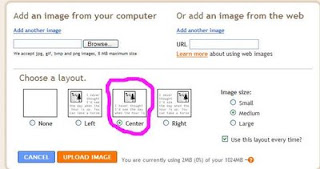
In your new post on blogger select the add image button (top of the post looks like a small picture of a mountain, hover your pointer over it it'll say "add image" while you're at it hover over the other buttons.) This window below pops up.
Click browse and navigate to were you saved your picture named "web..."
Important click center (circled in pink here) under choose layout, otherwise words and pictures get all messed up in placement and can be a pain.
Then click upload image and when the done button comes up, click done.
You can thendrag your picture around.
Tip the first picture you upload will be at the bottom to start with, the last at the top.
Step 5 Explore further and trouble shooting.
When you've had a chance to get your head around things click the layout tab and click "add a gadget" this is how you add links, pictures, and notes to the side of your page. They can be moved around, just remember to save them.
You may notice when posting the "edit html" tab at times this is useful, like when occasionally your writing appears blue and underlined. If this happens change to "edit html" you'll likely see a greater than sign followed by "/a" , next to a less than sign followed by an "a" click between these and hit enter to add some line breaks. Start to type in the gap and then change back to compose tab again.
Once you get to recognise which lines of HTML refer to your picture you can also copy and paste those lines around in edit html mode to move your picture.
Html script is what the computer sees, with all the instructions on what to do like, what font size to use, what colour the words should be, etc. Compose is what you see with the html removed. The computer automatically adds any html you need.
Occasionally the computer tells you it can't publish because of a problem with the html. Just make sure you've entered a title and click the blue "save now" button next to "publish post" then find someone to help you or save then try and fix it yourself.
David
Step 1 making the blog
If you want to make your own click on the link below
http://www.blogger.com
and you should see this.

Click the big orange create a blog button and follow the steps.
It's that easy.
You will need an email address and a password. You will also need a name for your blog.
When you get to the naming stage you'll need to check if the name you want is available or taken, it may take several goes to get one that's free. (Don't worry It won't affect what you call your blog in it's title.)
If you are a Heretaunga kindergarten and you want one that looks like this one, in the Heretaunga style, you can either
a) play around and work it out your self.
or
b) email me for the script we use and instructions on how to paste it in once you've set it up.
or
c) easier once set up go to settings tab, permissions link and then invite Hunter Park by email to contribute to the blog and once we accept give us admin privileges and I'll do it for you.
or
d)easiest email me at Hunter Park to set you up a blog and I'll set it up and invite you in and then make you admin.
Step 2 Get your settings right.
You will want to click the settings tab and go to "settings" tab and go to comments, select always moderate comments and make sure you save your settings.
You will then want to go to permissions and select who can see your blog and invite other people you want to contribute to it. Once again save your settings.
You may also wish to adjust formatting to give the correct time zone (and then save your settings)
And also check your settings under basic, for instance you should have the no button selected under adult content.
Step 3 Start posting.
You do this by clicking new post, under the "Posting" tab.
(If you're in a Heretaunga style blog you'll probably have to click the button that says "blogger" on the right hand side of your blog site to get there.)
Then you simply type, check what you've typed and click publish post (orange button button left you made need to scroll down.)
Remember to click "view blog" tab to see what it looks like.
Made a mistake? Hit the back arrow (top left of browser window) and click edit post. Fix the mistake and then press "publish post" button again.
A useful button is the abc tick button, this is a spell check.
Step 4 pictures
Make sure you have permissions to put them up, or use no identifiable pictures (backs of heads etc). make sure they are appropriate.
Next in my pictures (or were ever you store them) right click on the picture you want to put up, select open with then follow the arrow to select microsoft office picture manager.
The picture pops up with a toolbar, click edit pictures on this tool bar.
The edit pictures tools should now appear, first crop if needed then select compress pictures.
Select compress pictures for web pages and press okay.
Then go to file and select save as (if you click save your original will be altered which you often don't want.) Name the photo web and a name eg "web sandpit 1" the web part helps you find it easily later as they'll all be together, usually at the end of your file.
Then alter other pictures next to it, using the left right arrows at the bottom or close picture manager. It will ask you if you want to save changes, again tell it no, unless you want your original changed.
(We make pictures smaller because they take a lot less time to upload and use less of the bandwidth you've been allocated by blogger. Plus it makes them harder to misuse.)
In your new post on blogger select the add image button (top of the post looks like a small picture of a mountain, hover your pointer over it it'll say "add image" while you're at it hover over the other buttons.) This window below pops up.
Click browse and navigate to were you saved your picture named "web..."
Important click center (circled in pink here) under choose layout, otherwise words and pictures get all messed up in placement and can be a pain.
Then click upload image and when the done button comes up, click done.

You can thendrag your picture around.
Tip the first picture you upload will be at the bottom to start with, the last at the top.
Step 5 Explore further and trouble shooting.
When you've had a chance to get your head around things click the layout tab and click "add a gadget" this is how you add links, pictures, and notes to the side of your page. They can be moved around, just remember to save them.
You may notice when posting the "edit html" tab at times this is useful, like when occasionally your writing appears blue and underlined. If this happens change to "edit html" you'll likely see a greater than sign followed by "/a" , next to a less than sign followed by an "a" click between these and hit enter to add some line breaks. Start to type in the gap and then change back to compose tab again.
Once you get to recognise which lines of HTML refer to your picture you can also copy and paste those lines around in edit html mode to move your picture.
Html script is what the computer sees, with all the instructions on what to do like, what font size to use, what colour the words should be, etc. Compose is what you see with the html removed. The computer automatically adds any html you need.
Occasionally the computer tells you it can't publish because of a problem with the html. Just make sure you've entered a title and click the blue "save now" button next to "publish post" then find someone to help you or save then try and fix it yourself.
David
Heretaunga Conference 2009
Heretaunga Conference 2009
Seminar 1
Why on Earth was Lynda Boyd wearing so many different hats?
Lynda was reminding us of all the many important roles we need have as teachers.
We need to be nuturers creating a place were people want to be and where they feel valued.
We need to be people who see the good in others, treat others as we would like to be treated and articulate that children deserve the best.
We need to be rolemodels and ambassadors for our own culture and provide an open door and a place to grow for the expression our children’s cultures and the two main cultures of
We need to have and share a sense of wonder, mystery, imagination, drama and make believe.
We need to be able to deal with difficulties that crop up positively and embrace challenges.
We need to be infectious optimists and innovators.
We need to be academic thinkers and researchers.
We need to be safety experts, evaluating risks and helping children minimise them while still being challenged.
We need to be quite workers in the back ground making sure everything keeps ticking, and at times be silent so other voices can be heard.
We need to share the fun and joy in life, laugh and share humour.
We need to display a respect for the past and hope for the future, convey a sense of time.
We need to find roles for technology and balance the use of the new and complex with the old and primitive.
We need to be financiers and recyclers, seeking funding and optimising our use of the public monies put in our trust.
We need to be storytellers telling stories that help children and their families make sense of the world, and become literate in all forms of media and communication.
We need to be listeners valuing children’s own creative expressions.
We need to be advocates for children, family and community.
Lynda had many more hats, and there were hats she couldn’t bring, but she was a great reminder of why we were there.
Seminar 2
Julie Nicholls talked about how communication happens, only 7% of what you receive comes from words, 38% comes from tone and 55% from body language. She also talked about common communication problems like went people are too busy thinking about what they’ll say next to hear what the person they’re talking to is saying.
She went on to explore
Next she introduced Neuro linguistic programming, the idea people can at times be body talkers, visual talkers or auditory talkers and that you can communicate to them more effectively if you can identify their current talker type.
She also talked about leadership.
Workshop
I then listened to Ben Warren from Pure Health Revolution in Havelock North. He had some amazing things to share about our own health, which he gave me permission to share here. I’ll give them their own post and probably several.
Seminar 3
Ment to be Dr John Langley looking at leadership and direction in education of the next decade, instead due to unforseen circumstance we had Graeme Ballatine presenting ideas and practical exercises on public speaking. Introduction, Body, conclusion or PREP point of view, reason, examples and point of view.
Day 2
Seminar 4
Henare O Keefe presented an inspirational service on how leadership is all about service by the leader, not to the leader and how we need to be ruled in our lives not by fear and aggression but by love and boundaries.
Bad happenings (and Henare was able to share personal examples that would curl your toes) have the potential to inspire equally terrible consequences when you allow fear and aggression to rule you but they also have the potential to inspire truly great acts of community and fellowship when you choose to let love and boundaries rule your life instead. How you choose to let them inspire you is your choice. Bad experiences do not condemn you to bad results, but can be used to give you a greater strength for good, when you choose to, especially when you are surrounded by love.
Basically when everything hits the fan you can wallow in it, complain about the stink, or scrape it off, take it to the garden and compost it to grow beautiful flowers and food for your community.
Seminar 5
Chris Lepper then challenged us to unpack what we meant by all the big words we use in education and ask were we really doing what we say we do.
Two words she focused on, words she thought were often confused were;
Assessment: Noting changes and growth that have taken place in a child’s life.
and
Evaluation: examining how those changes resulted from the teaching that took place and environment provided and what you could do better.
She also focused on what is learning?
To me learning is :adapting to an ever changing personal environment and needs.
Seminar 6
Camberly Kindergarten presented a brief introduction to the work they’re been doing with the local community development programme and how since joining it they’ve brought an early childhood focus that was previously missing and yet so vital. It’s also made them aware that in times of high seasonal work, kindergartens may need to be open weekends to met parent and children’s needs.
Seminar 7
Peterhead kindergarten shared their journey recognising and celebrating the tuakana teina relationships that occur at kindergarten. One of their greatest innovations has been shifting from the traditional take the oldest child on the waiting list approach to one of bringing in younger siblings off the waiting list.
Another important thought was that sometimes you need to step back and let the children be the tuakana.
I think this is so true, especially in these days of smaller families. It is so important children get a chance to be a big brother or sister and a little brother or sister, if not to their own family then with their friends at kindergarten. It also emphasised the importance of younger ( and older) siblings coming on visits to the kindergarten, especially now many of us no longer have playgroups with our extended sessions.
Seminar 8
Irongate then shared their ICT journey emailing learning stories to families and how this had brought the parents who never get in to kindergarten due to work etc more fully into kindergarten life, as well as avenues this had opened up as stories were forwarded on to relatives around the world.
We’ve used the idea of emailing stories before with great success and have been looking at more fully utilising them, alongside e profiles, so it was great to see it fully implemented and working well.
Seminar 9
Was a presentation by Karen Sewell the secretary for education, and entertaining speaker, she talked about leadership, change and direction for the future in early childhood.
We finished with social networking time.
A great conference with a great venue in the opera house, great food and great company.
Actions
I will be putting up some of Ben Warren’s tips on healthy eating.
I will be putting up information on how to blog and actively supporting other Kindergartens interested in blogging.
I will be exploring e profiles with the team at Hunter Park and at Lakeview with my own son.
I will be exploring exporting stories to PDF format for emailing with the Hunter Park team.
David
Tuesday, July 7, 2009
Transition to school Network meeting
You want your child to have a great start at school. To take all the skills, strengths and dispositions to learn and think that they’ve grown at home and kindergarten in their last five years of life and use it to make their start at school a success and so do we.
As part of this the teaching team joined about 40-50 early childhood and primary teachers at a teacher’s network meeting in Napier on Monday night. There Jocelyn Wright and Keryn Davis presented an overview of the work that is happening in
One of the first items they raised is studies showing that what school teachers perceive as the most important things in the role of early childhood teachers in preparing children for school, and what early childhood teachers perceive as most important in their role in a child’s preparation to start school, are often two different things.
In order to bring these differing ideas together schools and early childhood centres need to make sure both are regularly and frequently communicating and listening to each other, in high quality ways, about the things that are important to them, in order to complement each others approaches.
So how is that communication is happening.
There are now strong links between the new school curriculum and Te Whariki the early childhood curriculum. But while the links are strong meetings (like the one we held last year, and the Excellence in new entrants teaching meeting we attended this year) between teachers from both sectors are needed to ensure their interpretations (shaped by differing experiences and pressures) match. After all a diamond and a lump of coal are both made of the same stuff interpreted in different ways. Fortunately these meetings are now becoming more common and frequent events.
Tied to the new school curriculum learning stories (narrative assessment) have started to make their way into schools, both early childhood ones shared by the child of their experiences prior to school and ones written by the teachers, parents, relatives, friends and the children themselves at school. By sharing assessment methods, there is a greater continuity for both the child and the parent.
However when teachers (and parents) are new to learning stories, it is not always easy to know what (if anything) is expected in them, or what information they hold or hold to find and use it. One common question teachers have is how many should I write? Another is how will I find the time? And of course, what am I meant to write? (My sister in law said, my Kindy teachers gave me this piece of paper with photos and a story and I was supposed to write something on it, but I don't know what I'm supposed to put.)
These aren’t so much problems as fears of the unknown. The answer is just start and write something, anything, take a risk and don't worry about making mistakes. Children aren't born afraid, sure they fall over when they toddle, but that doesn't stop them getting back up, the more they do the better they get. So don't be afraid of making mistakes just start and have a go.
Some times it's nice to have a guide though so schools have been sending teachers to visit early childhood settings and learn about how they use and write learning stories. They have also been bringing kindergarten profiles into the school classrooms, watching how children use them, writing their own stories for them and using them as literacy artifacts (reading material) with the children. After all what better stories to read than stories about yourself, that you really have experienced. As an added bonus the profiles themselves have acted as a link and a source of continuity for the children.
A further result of this new collaboration are phamplets, DVD’s and blog sites that are being prepared and developed by schools, parents and kindergartens all getting together. The end product aimed providing the information needed to give children and parents a smooth transition from school to earlychildhood, and this is just great.
One thing I’m especially excited about are the online possibilities to collaborate. While you might not feel able to drive out half an hour or more to have weekly conferences with every rural school your kindergarten feeds into, how easy is it to just click on their blog to find out what’s happened at school that week, exchanged emails, used wiki’s to develop joint understandings and forums to exchange ideas.
Plus when you have links to the school site on your blog, parents and future pupils can become familiar with the school and catch up on old friends, with a simple click.
Naturally the communication goes two ways (and indeed in multiple directions as families, friends and children join the mix) to build the links communities are built on.
Of course not all the learning from the night was strictly from what was presented. One incidental revelation I had was seeing the formulaic term child’s voice: parents voice sometimes seen on learning stories, replaced with real names in some of the stories used. Ben’s voice, Polly’s voice, Grampies voice.
After all what child refers to themselves as child? What child (or person) doesn’t recognise and show an interest when they see their name (rather than a generic label really only meant as a place holder).
Talk about a slap my head and realise that I hadn’t been seeing what was in front of my face, till seen from a new light, moment. I’m not even sure I use "Child’s voice:" but I’ve certainly seen it used, as I have Parent voice, and I’ll be on the watch for it now.
For schools thinking about starting on the learning story journey, Jocelyn and Keryn have offered to put them in touch via email with those already started to help dispel any fears of the unknown that may crop up. We have their emails if you want to get in touch.
Two actions I'll be taking as a result of this meeting (plus seeing it on other kindergarten blogs I've been researching, some ideas I've been playing around with for a while about ipod based e profiles, and the 2 day course in Hastings) is adding links to local schools to our blog, and also experimenting with e profiles.
E profiles are online profiles build as an equal partnership of parents, children and teachers all feeding into an online blog. They don't need to be open, you can choose to restrict access to them to only people you invite, but we will be sharing my boy Ben's e profile as an exemplar as we explore the possibilities with my family and his teachers at Lakeview Kindergarten, and then hopefully his teachers at school just before and after he starts there when we invite them to become contributors too.
David
Friday, July 3, 2009
Last Day of term
Last day of term and we said goodbye to Sam and Jake. They've been great to have at kindergarten and we'll miss them heaps, but we wish them well as they continue their educational journey.
 Monica came in for morning tea and to be there to farewell the boys. We taught her how to make and play straw oboes.
 Outside I thought, Kate oboe, Kate balloon, and made my self a bagpipe, that Kate tried to replicate, but is still working on how to inflate.
Inside I found the videos from the volcano yesterday I'd misplaced and since the sound for Kate's oboe seems to have vanished in the process of being uploaded I've included this concert of hers.

 Monica came in for morning tea and to be there to farewell the boys. We taught her how to make and play straw oboes.Outside I thought, Kate oboe, Kate balloon, and made my self a bagpipe, that Kate tried to replicate, but is still working on how to inflate.
Inside I found the videos from the volcano yesterday I'd misplaced and since the sound for Kate's oboe seems to have vanished in the process of being uploaded I've included this concert of hers.
Well we're off of to have some professional time. We start with a two day conference and and evening network meeting in Hastings and Napier, then it's back for some maintenance and repairs, desk catch up, a day of professional development with Monica where we unpack the survey we sent out, and finally setting up for the new term. Hopefully with some family time, shopping for Sharon and garden catchup thrown in. Have a great break everyone see you next term.
David
Thursday, July 2, 2009
Volcanic Marshmallows
When we made the fire volcano Jack reflected we should have marshmallows, so he got Sharon to add it to the shopping list.
 Finally a fine day arrived, but it wasn't Jack's day. We rang and invited him to come anyway. Things were looking good till we got the call, brake trouble, he wouldn't be able to come in.
We decided to go ahead anyway and do it again another time for Jack.
So our presoaked skewers were slotted into holes on poles and sticks. Ready to cook.
 Onto the fire. After some false starts in the saturated sand (5 days of solid rain) we got it going and the chorus of "can I have a turn" changed to munching as we went into high gear, barely able to keep four sticks loaded.
 Some were better cooked than others.
 Once cooked you simply pulled of the skewer and ate your marshmallows while the next person's stick was loaded on the pole.
 Yum! Once everyone had had a turn, (in some cases several) we went inside to have our lunch.
Finally a fine day arrived, but it wasn't Jack's day. We rang and invited him to come anyway. Things were looking good till we got the call, brake trouble, he wouldn't be able to come in.We decided to go ahead anyway and do it again another time for Jack.
So our presoaked skewers were slotted into holes on poles and sticks.
Ready to cook.Onto the fire. After some false starts in the saturated sand (5 days of solid rain) we got it going and the chorus of "can I have a turn" changed to munching as we went into high gear, barely able to keep four sticks loaded.Some were better cooked than others.Once cooked you simply pulled of the skewer and ate your marshmallows while the next person's stick was loaded on the pole.Yum! Once everyone had had a turn, (in some cases several) we went inside to have our lunch.
As well as sharing fire stories the children shared their cooking marshmallow stories from home and camping.
And as usual we repeatedly pushed the fire safety message.
David
Subscribe to:
Posts (Atom)


